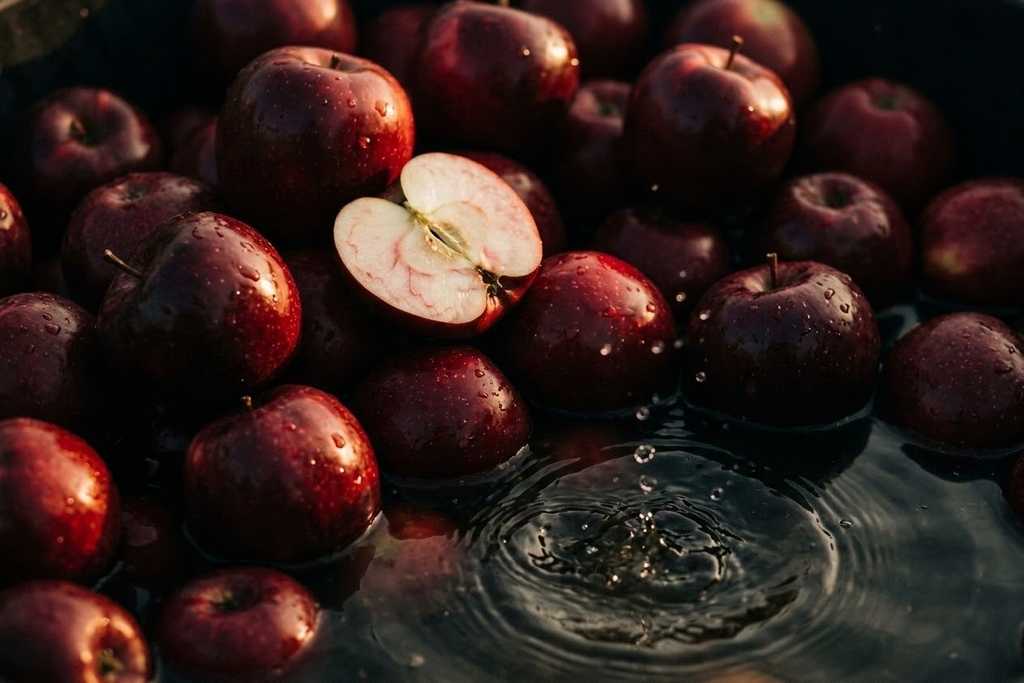


“Once upon a time it was cold, and the wind never really stopped, up where I first grew wild and small in the mountains, tucked between rock and thin, high air. I might have stayed there forever if a traveler hadn’t passed through one day, pockets full of seeds, curious about the strange, tart little fruit growing along the path. They picked me up and carried me west, trading me along the way, planting a piece of me wherever they stopped. Somewhere in that long journey, I stopped being wild. I picked up new colors, new shapes, a sweetness I hadn’t had before, and, along the way, an enormous, sprawling patchwork family of relatives who barely resemble each other and somehow all still answer to the same name: apple.”
Apples have carried a bit of that mystery with them ever since. In the U.S. today, harvest starts as early as August and runs into November, depending on the variety, with the bulk of it concentrated in Washington State, which alone grows around 60% of the country’s apples, followed by New York, Michigan, and Pennsylvania, the other states rounding out the country’s apple map. Mid-September, right when this story is being told, lands squarely in the middle of that window, the point where the early varieties are already in and the main harvest is picking up speed. Along the way, that one small, sour fruit from the mountains turned into thousands of different apples worldwide, each one a little different from the last, proof of just how far a single wild seed can wander before it settles into something new.
It’s also, as it happens, exactly the kind of fruit that keeps showing up at the center of trouble it never really caused. A golden apple started a divine argument that spiraled all the way into the Trojan War. A poisoned one nearly ended Snow White. And in the Bible, the fruit from the Tree of Knowledge was never actually named as an apple at all, that detail came later, through a bit of Latin wordplay (malus meaning both “apple” and “evil”) that stuck around far longer than the translation error that caused it. Every so often, though, the apple gets to be the good guy for once, like the one that supposedly fell on Newton’s head and got him thinking about gravity. A strange reputation for something that, eaten plain, has never hurt anyone, apart from those with an allergy.
A Taste Of Temptation
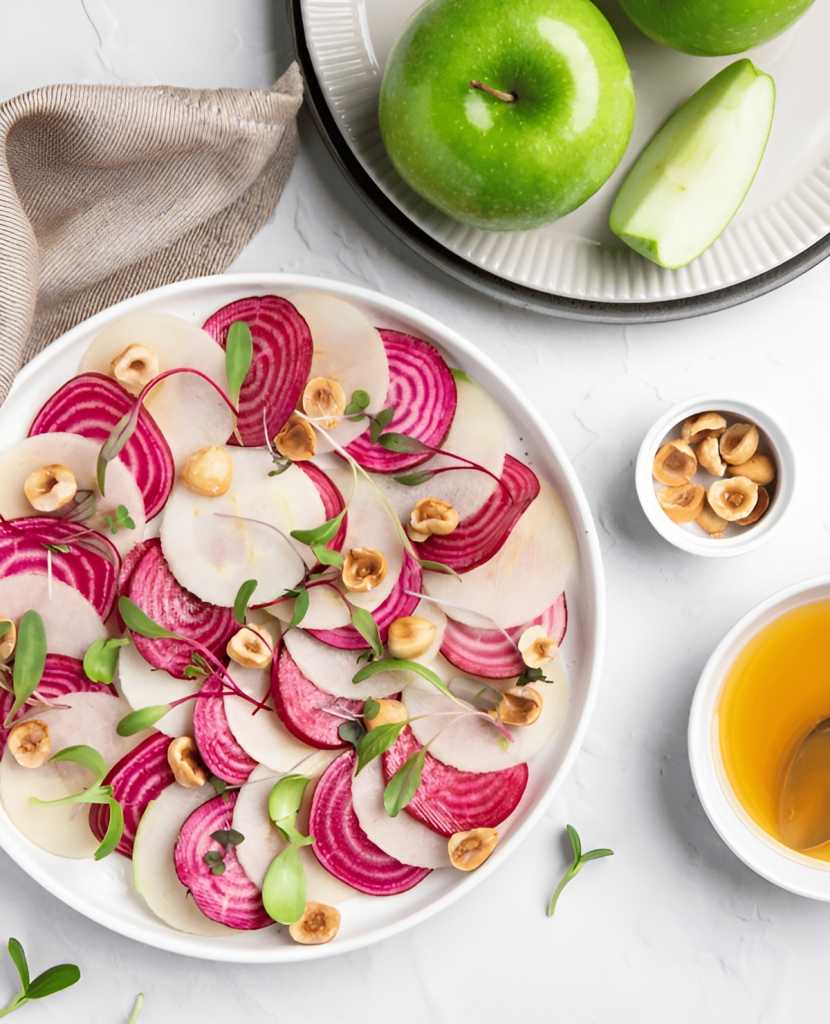
That misplaced blame turns out to be part of the story too, though, because temptation has followed the apple around ever since, whether deserved or not. It shows up here dressed in deep, glossy red. Carpaccio traditionally means thin, raw slices of beef, named after the Venetian painter Vittore Carpaccio and his love of deep reds in his work. This version trades the beef for something fresher and crunchier, but keeps the same rich color, and even some of the same iron, courtesy of the beetroot standing in for the meat. The Apple Beetroot Carpaccio thinly slices raw Washington Granny Smith Apple, firm and tart enough to hold its shape and its bite even sliced paper-thin, and beetroot into overlapping rounds, brought together with a maple-mustard vinaigrette and a scatter of crushed roasted hazelnuts, a smaller, veggie-forward sibling of the original. Unlike the fruit in the old story, no one has to talk themselves into taking a bite here.
That temptation to take a bite? Turns out there’s a whole party game built around it. No old-school party would be complete without apple bobbing, that classic game where you dunk your face into a tub of water and try to catch an apple with nothing but your mouth. It works out better than it should, mostly because apples are about 85% water themselves, and, fittingly, most of them float. And despite how at home apples feel in American orchards today, they’re not originally from here at all. Kazakhstan, not the U.S., is where the story actually started. North America did have its own wild apple all along, though, a small, sour crabapple that evolved on its own, completely unrelated to the one that eventually made its way over from Central Asia.
A Little Oven Magic
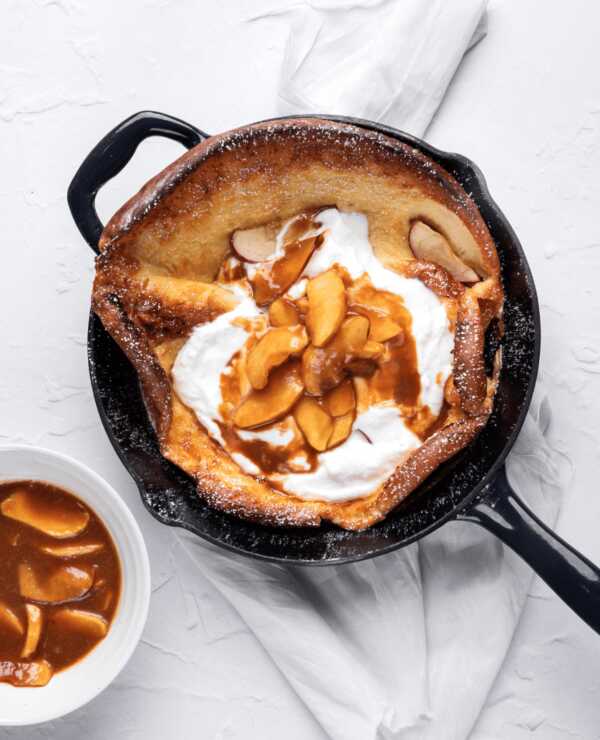
The Dutch Baby Pancakes start as nothing more than a thin, unassuming batter of eggs, flour, milk, and butter, blended and poured into a hot pan. A few minutes in the oven, though, and it puffs up into something dramatically different: golden, billowing at the edges, more like a soufflé than a pancake. It gets topped with Washington Gala Apples, soft and sweet enough to break down into that glossy, jammy texture once cooked, caramelized in butter, sugar, and a pinch of cinnamon until soft and glossy, plus a bit of cream.
That kind of transformation isn’t so far off from what happens with apples themselves. Every seed inside an apple grows into a slightly different tree than its parent, which is exactly how one small, sour fruit from the mountains eventually became the thousands of varieties, and around 2,500 in the U.S. alone, that exist today. No two are ever quite the same, in the oven or in the orchard.
Hiding In Plain Sight
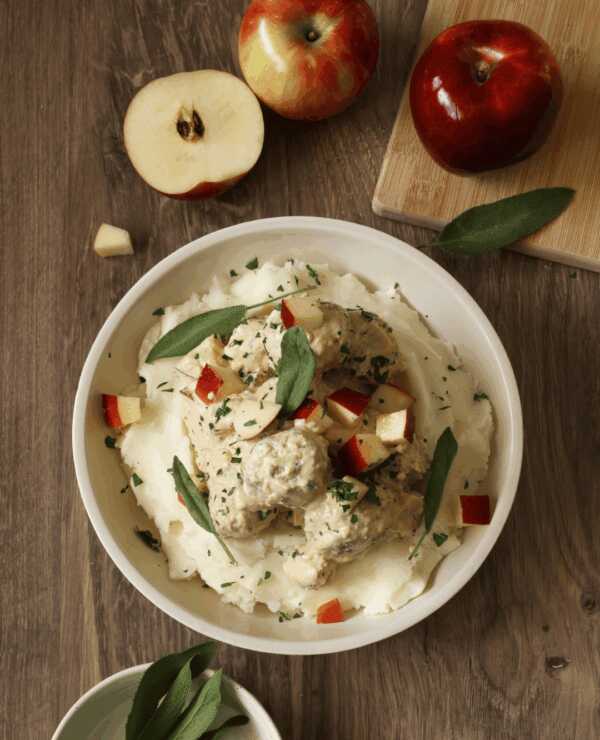
Not every character in a good story is what they first appear to be, and the apple here plays that part perfectly. Apple Pork Meatballs in Creamy Dijon Sauce grates Cosmic Crisp Apple right into the pork mixture, where it disappears completely, keeping the meatballs moist without ever announcing itself, then a diced apple gets stirred into the sauce at the end, a Dijon-cream base rounded out with sage, parsley, and cheddar.
Cosmic Crisp is about as Washington as an Apple gets, developed and grown almost exclusively there. In growing regions like Okanogan, orchards big and small are right in the middle of that harvest push this time of year. A good share is also grown organically, on more than 16,000 certified organic acres statewide, helped along by a dry climate that naturally keeps pests and disease in check, meaning less need to intervene in the first place.
A feast like that deserves a bit of a lie-down afterward, and the apple can lend a hand there too. Apples are a good source of pectin, a soluble fiber known to absorb water and form a gel-like substance as it moves through the digestive tract, and to serve as food for gut bacteria. A medium apple also comes with a solid dose of vitamin C, along with small amounts of vitamin A, E, and folate.
Tales From Colder Waters
Not every good story is about one hero. Some are about two unlikely characters who have no business working together, and somehow do anyway. Apple and salmon fall into that category more often than expected, and the pairing goes back further than either of them might get credit for: centuries before anyone understood vitamin C, ships carried apples on board as one of several guesses at warding off scurvy, right alongside barrels of salted fish, the two staples of any long voyage.
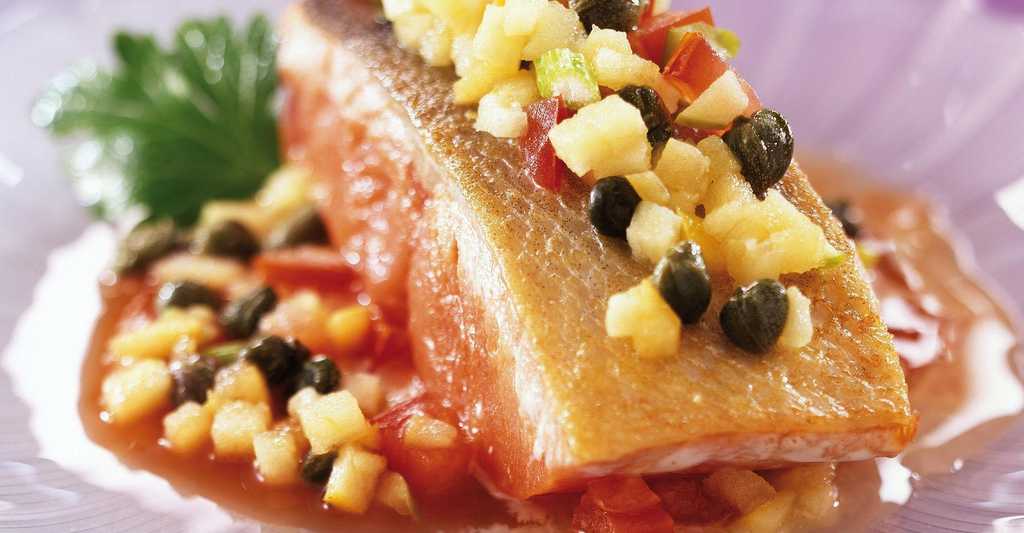
Wild Alaska Salmon Fillet with Apple puts that old pairing back on the plate, and doubles down on it: steamed Alaska Wild Salmon fillet is served over a fine dice of not one but three apple varieties, Granny Smith, Boskop, and Renette, sautéed with bell pepper, tomato, and mushroom, finished with a light butter sauce brightened with lemon and capers.
Happily Ever After

After a feast that long, it’s easy to lose track of time entirely, until suddenly it’s almost midnight. Best to head home before the magic wears off, and there’s a trail to follow: the warm, buttery scent of caramelized apples and pie dough drifting from a kitchen somewhere nearby. That’s where a Washington Apple Pie is coming together, a homemade flaky butter crust filled with sliced apples tossed in white and brown sugar with cinnamon, baked until the crust turns golden and the filling bubbles through the vents, then left to rest for a couple of hours before it’s sliced. Served warm, with vanilla ice cream melting into the crust, it’s about as classic an American dessert as it gets.
That kind of old-fashioned comfort runs deep in Washington’s apple history, in ways that go beyond the fruit itself. Long before the plain cardboard box, apples used to ship in wooden crates, each stamped with its own brightly colored paper label, part advertisement, part tiny piece of art. Growers competed to make theirs the most eye-catching, and today those same labels, once just packaging, have become collectible pieces of Americana in their own right. A century-old habit of dressing up something ordinary until it felt a little more special, not unlike sending a plain apple off with a scoop of ice cream and calling it dessert.
A Glamorous Encore
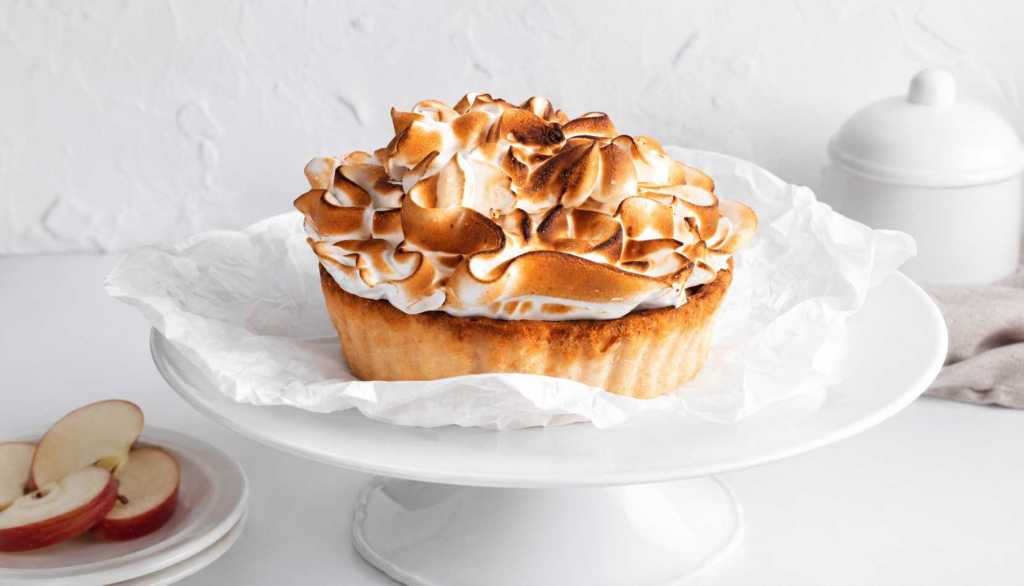
The story could end right there, warm and full and home for the night. The Apple Raspberry Meringue Tart layers a buttery tart shell with raspberry gel, a caramel-cream apple filling brightened with cinnamon, vanilla, and lemon, then finishes with Swiss meringue piped and swirled into soft, cloud-like peaks, more crown than dessert.
If any apple deserves that kind of royal finish, it might be the Lady Apple, a tiny, glossy variety once so prized by French royalty that Louis XIV reportedly considered it the only apple worth growing. It didn’t stay a European luxury for long, though; colonial growers brought it to Virginia, where it’s been cultivated ever since, small enough to fit in a coat pocket and pretty enough to hang on a Christmas wreath.
Once Upon A Screen
Every story gets retold a little differently with each generation, and this one is no exception. Digging through the archive turns up a name that hasn’t been used in decades: the Washington State Apple Commission, back before it dropped the “State” and became simply the Washington Apple Commission, a small clue that pins these clips to somewhere in the 1980s. Same apples, same state, just a slightly different name and a lot more static on the tape. A little slice of apple history, straight from the archive: